
Monday, July 7, 2008

Wednesday, June 18, 2008
Basic Days

Values and Atmosphere problems
Black and white of the three basic days; sunlight, skylight, and moonlight. The left column is lighter than average, next is the average, and third is darker than average. The column on the right is the average in color. Row four is stages of atmospheric perspective.
Saturday, May 3, 2008
Foliage Greens
I've started planning some large landscape paintings, which has inspired me to study the few hundred pages of Reilly Landscape Program notes I have. The Landscape Program: Outdoor Painting, like the "Reilly Method" total, is based upon concepts he learned from his teachers Frank Vincent DuMond, George B. Bridgeman, as well as the immense influence of Dean Cornwell.
Foliage greens and a clear blue sky.
Before doing the exercises one question needed to be answered...
Since my notes contain a number of palettes (including DuMonds) I needed to determine which I feel would be most useful. Here are some tests..
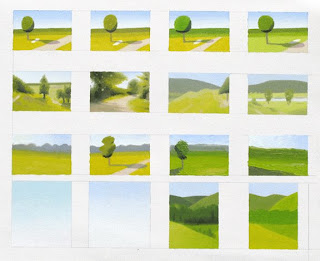
The top row is 4 different palettes painting the same abstract landscape.
The second row is the palette directly above used to paint color notes of 2 Peder Monsted and 2 Dumond landscapes.
The third row is the 3rd palette from the left used to paint 4 more abstracts.
The fourth row shows to sky gradations from the zenith to the horizon, and color-notes after Thomas Anshutz. First is a blue-green zenith to a blue-purple horizon, second is a blue-purple zenith to blue green horizon. The Anshutz was done with the third palette.
Obviously I've decided that the foliage greens string of the 3rd palette has the greatest inherent possibilities, and will use it as the foundation for further study. For the Munsell in you: 5Y/8/10, 5GY/7/8, 5GY/6/8, 5GY/5/8, without the "big book" I'm not sure of values 4,3,2 but they continue going blue. Value 2 probably being 2.5G, all grayed with a PB string of white and lamp black.
here is my Monsted color-note at life size 2" x 3"

Foliage greens and a clear blue sky.
Before doing the exercises one question needed to be answered...
Since my notes contain a number of palettes (including DuMonds) I needed to determine which I feel would be most useful. Here are some tests..

The top row is 4 different palettes painting the same abstract landscape.
The second row is the palette directly above used to paint color notes of 2 Peder Monsted and 2 Dumond landscapes.
The third row is the 3rd palette from the left used to paint 4 more abstracts.
The fourth row shows to sky gradations from the zenith to the horizon, and color-notes after Thomas Anshutz. First is a blue-green zenith to a blue-purple horizon, second is a blue-purple zenith to blue green horizon. The Anshutz was done with the third palette.
Obviously I've decided that the foliage greens string of the 3rd palette has the greatest inherent possibilities, and will use it as the foundation for further study. For the Munsell in you: 5Y/8/10, 5GY/7/8, 5GY/6/8, 5GY/5/8, without the "big book" I'm not sure of values 4,3,2 but they continue going blue. Value 2 probably being 2.5G, all grayed with a PB string of white and lamp black.
here is my Monsted color-note at life size 2" x 3"

Thursday, April 17, 2008
Rockwell, Yankee Doodle

Norman Rockwell
"Yankee Doodle", Mural for the Nassau Tavern, Princeton, New Jersey -1937
http://www.nassauinn.com/
More insight on drawing the idea/ideal as opposed to copying. In this mural Rockwell depicts yankee doodle amongst laughing redcoats. How does he transform his faithful study of a model in order to depict his idea of yankee doodle. Yankee doodle the visual personification of the gangly and awkward young America.
No doubt there were sketches done before employment of a model, I've never seen them so will have to start one step into the process.
1- A drawing is done from the model (life or photo), changes are made but the character is still of a model posing~average proportions and the action not fully acted.

2- A drawing is done from the first drawing (with new reference used according to the changes made). In this way ideas(shapes/character/action) started or hinted at in the first drawing can be pushed further. Here the body is made thinner, the arms and legs are elongated, and the shape of his nose is changed. The clothing also adds to the character and his action. The vest now creates a more interesting silhouette, while the smaller scarf helps thin the shape of his upper body. The negative space between him and the saddle, as well as disheveled hat and flowing hair and coat, combine to convey a bouncing ride.
At this point the first drawing now looks like it depicts the lord of the manor, not our boy YD.

3- The drawing is transfered and a color-study is done.

4- Even from the color-study to the finish changes are made. Most are subtle, but the key one here is the improved resolution to the coats flowing pipe folds, and its corresponding change to its negative shape in relation to the elbow. Every brushstroke is a drawing consideration.

Wednesday, March 19, 2008
Gerome and the use of Photography
Thinking - Drawing - Picture-making
Intelligent use of reference, i.e. not copying, wether done from a photo, computer program or from life. Reference meaning that which is referred to in order to produce your image, again not copied.
Presented here is the photo reference of a model and the study (#69- "Officier arnaute", 1857) of the same for the larger work #67- "Recrues egyptiennes traversant le desert" of 1857.
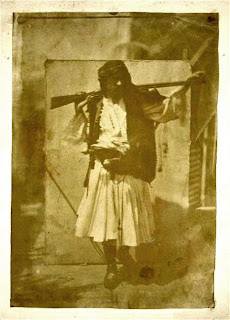
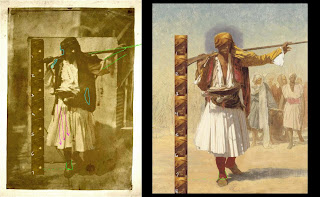
Key changes made by Gerome in order to enhance the character and convey the action.
1- An extra half-head length was added changing him from a 6 3/4 to 7 1/4 head figure. Making him more heroic and less squat.
2- Negative shape was added to accentuate the position and narrowness of the hips, better defining the contour of the body. For similar reasons a negative shape was added near the neck/head. The lack of cloth there both thins the head and better defines the form. It should be noted a different headdress and some other minor garment changes were made, probably modeled on a dummy in the studio or possibly based on another shot from the photo-shoot.
3- The barrel of the gun is extended, allowing the arm to extend to a more elegant angle. The angle of the gun is also slightly changed to echo the new tilt of the shoulders, subtly adding to the movement of the figure.
4- The cleverest alteration is the change in direction of the folds of the skirt. They now echo and therefore imply the form of the leg beneath, and give the feeling of forward movement.
This study also shows Gerome's technique:
1- A careful drawing that is transfered and inked.
2- A color wash-in (thin layer of color applied with turpentine and perhaps some oil or resin).
3- Parts are rendered to a finish or near finish. Only parts of the main figure have been painted over the color wash-in.
4- What needs touching up is finished.
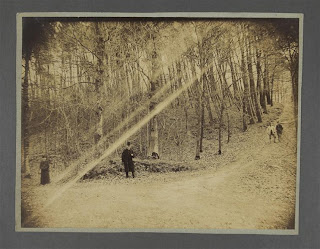
#359- "Scene de chasse dans la foret de Meudon", 1889
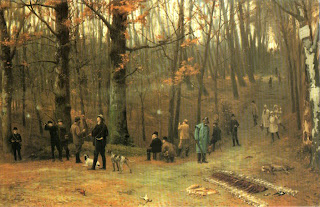
* the numbers preceding titles denote the catalogue raisonne entry
For a cursory look at the importance of photographs on the work of Gerome pupils and others I would recommend the book "Beyond Impressionism: The Naturalist Impulse in European Art 1870-1905" by Gabriel p. Weisberg.
Intelligent use of reference, i.e. not copying, wether done from a photo, computer program or from life. Reference meaning that which is referred to in order to produce your image, again not copied.
Presented here is the photo reference of a model and the study (#69- "Officier arnaute", 1857) of the same for the larger work #67- "Recrues egyptiennes traversant le desert" of 1857.


Key changes made by Gerome in order to enhance the character and convey the action.
1- An extra half-head length was added changing him from a 6 3/4 to 7 1/4 head figure. Making him more heroic and less squat.
2- Negative shape was added to accentuate the position and narrowness of the hips, better defining the contour of the body. For similar reasons a negative shape was added near the neck/head. The lack of cloth there both thins the head and better defines the form. It should be noted a different headdress and some other minor garment changes were made, probably modeled on a dummy in the studio or possibly based on another shot from the photo-shoot.
3- The barrel of the gun is extended, allowing the arm to extend to a more elegant angle. The angle of the gun is also slightly changed to echo the new tilt of the shoulders, subtly adding to the movement of the figure.
4- The cleverest alteration is the change in direction of the folds of the skirt. They now echo and therefore imply the form of the leg beneath, and give the feeling of forward movement.
This study also shows Gerome's technique:
1- A careful drawing that is transfered and inked.
2- A color wash-in (thin layer of color applied with turpentine and perhaps some oil or resin).
3- Parts are rendered to a finish or near finish. Only parts of the main figure have been painted over the color wash-in.
4- What needs touching up is finished.

#359- "Scene de chasse dans la foret de Meudon", 1889

* the numbers preceding titles denote the catalogue raisonne entry
For a cursory look at the importance of photographs on the work of Gerome pupils and others I would recommend the book "Beyond Impressionism: The Naturalist Impulse in European Art 1870-1905" by Gabriel p. Weisberg.
&
 |
| Gerome's Atelier |
Wednesday, December 12, 2007

Thursday, December 6, 2007

Sunday, December 2, 2007
Atlas Sketches

Studies done after "The King" Jack Kirby. Note how he would indicate the muscles of the leg and arm with a zig-zag line, and the bone with a smooth one, all of which emphasize the action of the form.
Atlas was issue #1 of DC's 1st Issue Special. He never made it past that issue so one can only guess at what Kirby would have done with it.
Friday, November 23, 2007

Saturday, November 3, 2007
Portrait Study

study of MB acrylic 9" x 12"
Reducing reality to the essentials, those salient characteristics that best convey the individual likeness of a form, and it's particular expression. How simple can you make? Regardless of degree of finish, clarity will give the work power, not the minutiae which needs to be subserviant to the whole.
Thursday, October 25, 2007


Saturday, October 20, 2007
Stills in Frames

MINI WHITE PUMPKIN 5" x 7" oil on panel

GOURDS I 11" x 14" oil on canvas
Two recent paintings from an ongoing series of still-lifes. They will be on display Oct.19 thru Nov.4, as part of a group exhibition featuring local artist of various disciplines.
for more information please visit
http://www.rahwayartsguild.org/exhibits.htm
Monday, October 15, 2007

Wednesday, October 3, 2007
Modern Academic Nude

14"(?) x 24" oil on canvas
Painted during my time studying at SVA under the instruction of John Murray. He was a former student of Frank J. Reilly and taught via the "Reilly Method", which I also studied at The Art Students League under Jack Faragasso. This painting has a section of the raw umber wash-in still visible. The small figure is a color-note/poster, an essential plan for your picture.
Saturday, September 22, 2007
Studies - Arms & Hands
9" x 12"

Study everything you want to draw or paint, whether you work from imagination or life. If you are unclear or confused about what you want to convey, then those that view your work will be even more confused.

Study everything you want to draw or paint, whether you work from imagination or life. If you are unclear or confused about what you want to convey, then those that view your work will be even more confused.
Tuesday, September 18, 2007
Landscapes
both gouache on board 5" x 7"


Two woodland-scapes with dappled light. Painted from collected reference (sketches, photos, plein air color-notes), from a recent hiking trip.


Two woodland-scapes with dappled light. Painted from collected reference (sketches, photos, plein air color-notes), from a recent hiking trip.
Saturday, September 15, 2007
Reilly abstracts & D. Hord
charcoal pencil on newsprint

Abstract conceptual studies of drapery, twisting and foreshortened form, and a study of a Donal Hord sculpture.

Abstract conceptual studies of drapery, twisting and foreshortened form, and a study of a Donal Hord sculpture.
Wednesday, September 12, 2007
Chas Curran Clouds
Two studies of cloudy skies I did from paintings by the American impressionist Charles Courtney Curran. Note the subtle color harmonies possible with-in a color scheme. Though both depict the same subject, each has its own distinctive color base. The first is blue-purple and the second is blue-green, all other colors play off of these in each painting.
both gouache on illus. board 4 3/4" x 6"


both gouache on illus. board 4 3/4" x 6"


Wednesday, September 5, 2007
Plein Air


both- Gouache on illustration board 4 3/4" x 6"
When painting a landscape study you have to be fast. In the northeastern U.S. during the summer between 10am and 3pm you have 20 minutes to possibly 30 minutes (even less time earlier or later in the day) before the light condition has completely changed. Creating light and shadow shapes far different than those you started with. I seek to capture the first impression of the relationship of the big light and shade shapes. Then I look for the progression of color and value changes within them. All desired detail would then be painted into this.
When painting or drawing always work big to small, simple to complex, and even when working in a tight window-shading manor keep the principle in mind, or you will loose the effect of light on form.
Monday, September 3, 2007
Fantastic Argoman
 |
| "Argoman" gouache 10"x15" on illustration board |
This character study was inspired by my recent viewing of the film "Come rubare la corona d'Inghilterra" aka Argoman superdiabolico (Italy), Argoman the Fantastic Superman (UK), Fantastic Argoman (Philippines: English title), How to Steal the Crown of England (UK), The Incredible Paris Incident (USA), etc. etc., directed by Sergio Grieco. Scored by the great Piero Umiliani.
Subscribe to:
Posts (Atom)